
Reynoldsburg Previous Residents Sources
A strong backward trail begins with the county parcel, then moves to the Recorder’s indexed document trail, archives, and historical household sources. Reynoldsburg addresses can fall in Franklin, Fairfield, or Licking County, so each property needs its own county decision. A current postal label is not enough. The county matters for a deed, tax record, Probate file, and older archive, while CML and RTHS supply regional and local household material.
| Source | Years | Where | Shows |
|---|---|---|---|
| Franklin Recorder historic index | 1804-1913 | Franklin Recorder historic assistance and counter | Recorded party and document trail; fire reconstruction context |
| Fairfield Recorder | Indexes and deeds from 1800; images online from January 1980 | Recorder and Ohio Land Records route | Early index channel and later document images |
| Licking Recorder and Archives | Early 1800s; archival deeds 1803-1918; mortgages 1851-1941 | Recorder and Records & Archives Center | Historic title books and archival deed material |
| City and telephone directories | 1928, 1932, 1936, 1939, 1944 verified local runs | CML and RTHS | Listed subscribers and historic occupants |
| Federal census | Latest released full census: 1950 | National Archives and genealogy-library channels | Household snapshot on its enumeration date |
| Maps and permits | Record-set specific | CML, archives, and city request channel | Building, land, or alteration context, not household membership |
The table is a calendar, not a promise of complete coverage. When a web result stops, the next move is the relevant Recorder counter, historic index, or archive, not a conclusion that the property had no earlier recorded history.
Reynoldsburg Previous Resident Trail
Use City GIS or the county Auditor address search to locate the county, parcel or PIN, situs address, legal description, and a recent transfer clue. Keep the recorded situs address separate from a mailing or tax correspondence address. The Auditor identifies a parcel and current record fields, but it does not prove every person who lived there. That first parcel step is especially important for Reynoldsburg because the city crosses three county record systems.
Franklin Recorder does not index property address, so the Auditor-to-parcel, legal-description, or party handoff is essential. Fairfield’s advanced property system separates location, deeded owner address, and taxpayer address. Licking’s viewer accepts an address, owner, or Auditor PIN and connects the map to report tools.
Reynoldsburg Previous Resident Deed Chain
The deed chain follows documents rather than assumptions. Read the current deed before chasing older names. Its grantee normally supplies the recorded ownership link, while the grantor and any prior-instrument reference point toward the prior transfer. Confirm the legal description or parcel at every turn. A matching surname can belong to a different property, even in the same city.
- Open the county Auditor record and save the parcel, situs, legal or plat description, and latest transfer clue.
- Search the correct Recorder with the party name, instrument number, parcel, book and page, or legal description where that index supports it.
- Read the current deed and identify its grantee, grantor, document date, and prior-instrument reference.
- Search the former grantor as a grantee, then repeat the process while checking the same legal description or parcel.
- When online material ends, contact the Recorder or archive for historic deed-book and index access.
- Grantor
- The party transferring an interest in a recorded instrument.
- Grantee
- The party receiving that interest. The role applies to that document, not a general residence claim.
- Chain of title
- The connected sequence of recorded transfers for one property.
- Legal description
- The plat, subdivision, lot, metes, or other formal property description that persists better than an old street form.
Note: property records document a recorded transaction or ownership interest. They do not identify every past household member.
Reynoldsburg Previous Resident Image Gaps
Online availability has different starting points in each county. Franklin reports more than 11 million recorded items and a historic deed index from 1804 through 1913, with courthouse-fire losses largely reconstructed. Fairfield has indexes and deeds from 1800, but its online images begin in January 1980. Licking’s public online record route is stated from September 22, 1997, while its older material is divided between Recorder and Records & Archives sources. These cutoffs explain why one address may require a counter visit even after an online search.
The Licking Recorder DTS Public Access gateway is a web starting point, and it does not supply a single universal historical cutoff for every instrument.
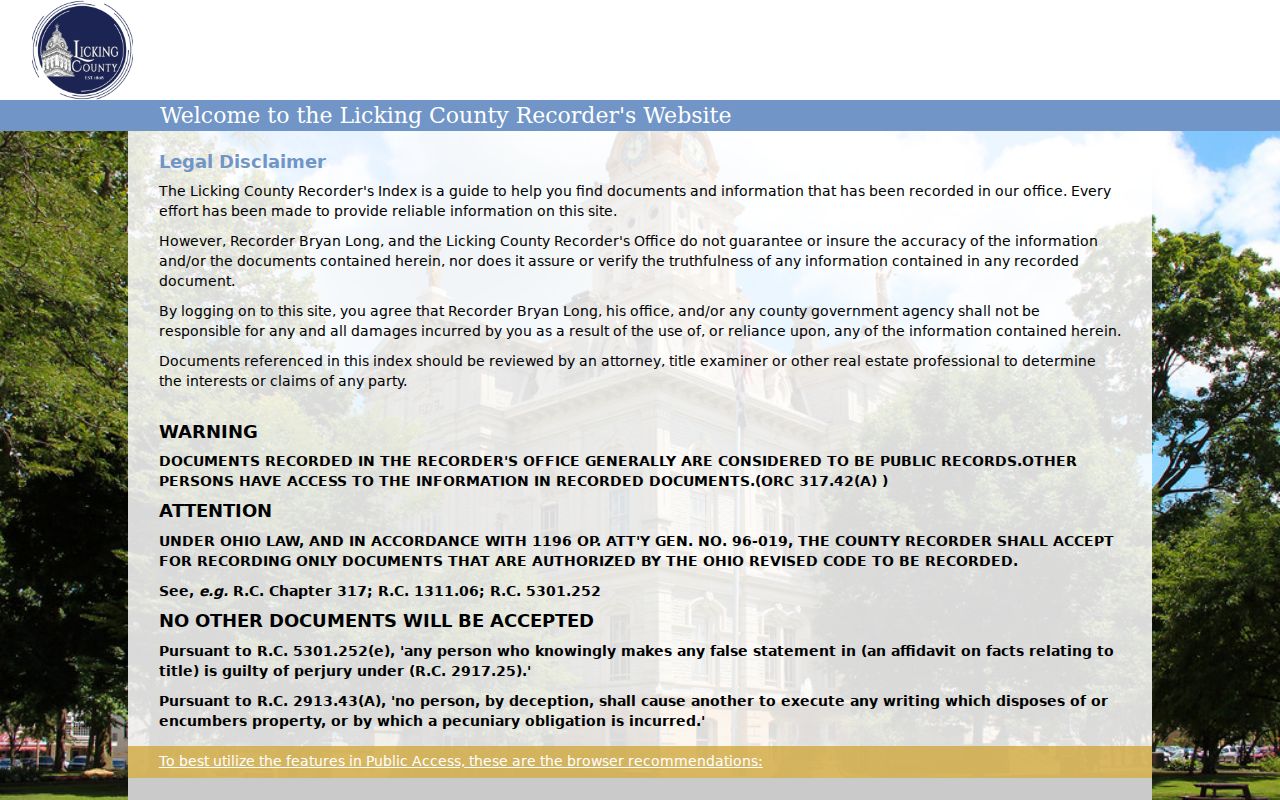
The Recorder-search image supports an indexed-document workflow. For an older item, ask about the historic index or deed-book channel rather than assuming an absent web image means an absent recorded document.
Each Recorder has a documented counter route for the local trail. Franklin Recorder is at 373 S. High Street, 18th Floor, Columbus, with historic-index assistance and a public-search gateway. Fairfield Recorder is at 210 E. Main Street, Suite 205, Lancaster. Licking Recorder is at 20 S. Second Street, Newark, while Licking Records & Archives is at 61 E. Main Street, Newark. A counter visitor can reach historic material that a current Reynoldsburg web search does not display.
Reynoldsburg Previous Resident Directories
Owners are only part of a house history. CML’s Ohio Bell books for 1928, 1932, and 1936, its 1944 directory, and RTHS’s 1939 Reynoldsburg Directory can identify listed subscribers or occupants at specific dates. CML says its city-directory street-address sections begin in 1911 and identify occupants, not owners. Pair those dated listings with the 1950 census, the latest full federal census now released, to test a household connection.
Use a simple flow: address or route in a directory, then the closest released census, then newspaper, death, or Probate evidence for a later endpoint. The collections, entry formats, and item-level coverage limits are detailed in the Reynoldsburg directory book. A directory name may be incomplete, misspelled, or connected to a route rather than a number.
RTHS’s 1939 source documents that historic Broad Street is current Broadwyn. Treat it as an address translation clue, not proof that all old Reynoldsburg streets share one renumbering history.
Reynoldsburg Previous Resident Building Maps
Maps and permits can explain a structure without naming a household. The 1872 Franklin County atlas labels Reynoldsburg streets, landholders, and local institutions. CML local-history material includes Ohio maps and house-history resources. The research did not verify a comprehensive Reynoldsburg Sanborn run, so a map year must be checked before it is used for a particular address. A map can date a footprint, street form, or surrounding development. It cannot establish who lived inside.
A focused city Building or Code Compliance request can seek a defined permit, inspection, or code record by certified address, parcel, date, or permit number. It may help date construction or alteration. It is not proof of continuous residence or a general list of former residents.
Reynoldsburg Previous Resident Archives
The Licking Records & Archives Center is a needed backup for the city’s Licking portion, especially where early deeds and mortgages leave the online route. Franklin’s 1879 courthouse fire and Licking’s 1875 fire are separate historical cautions. Surviving series, reconstructions, and gaps must be tested at the holding office. A current county assignment should not be projected backward into an earlier jurisdiction without parcel and history checks.
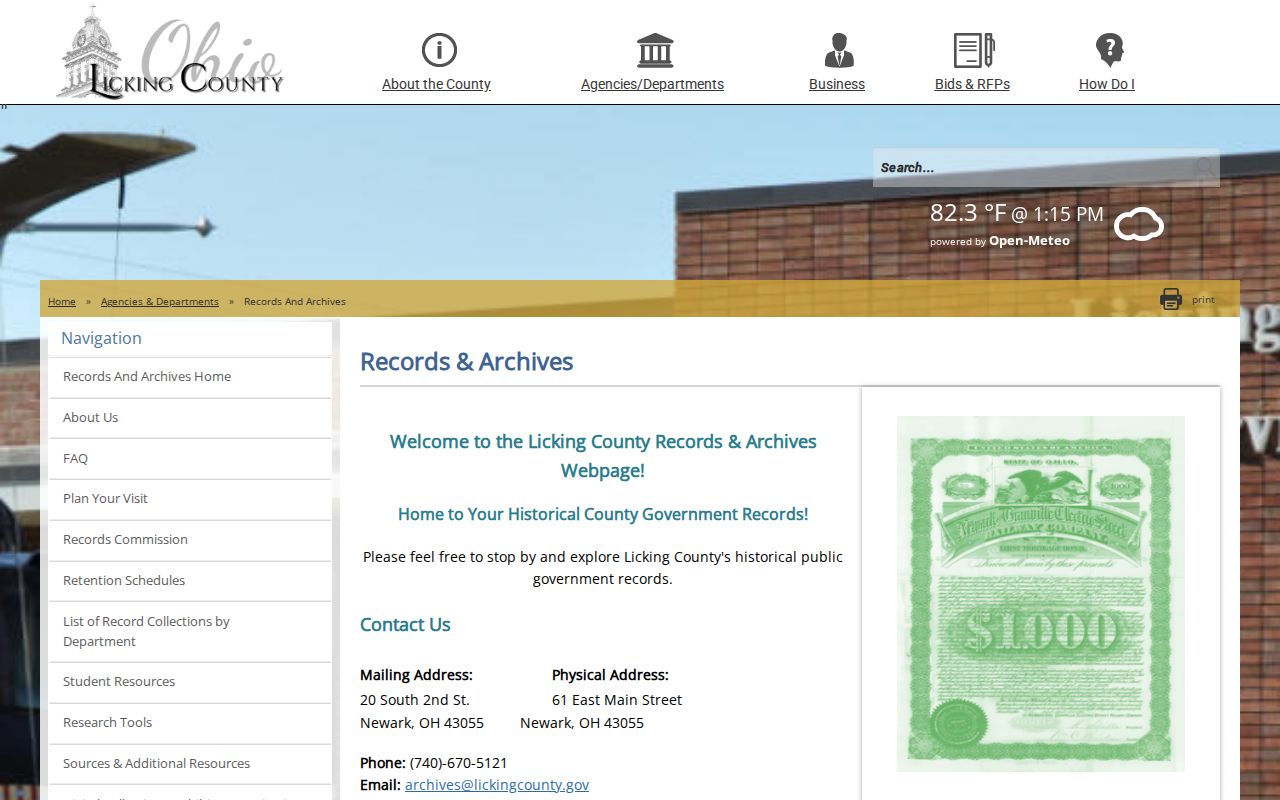
The archives image is a reminder that historic access has a physical channel. A focused request for an indexed period, deed book, mortgage series, or parcel-related record is more workable than an untargeted request for everything about a house.
RTHS’s database also describes 1920-88 parcel sheets and 1895-1940 Franklin tax maps, useful for linking growth and annexation context to a directory or deed date. These materials add context, not title certainty.
For Reynoldsburg property research, a request under the Ohio Public Records Act can seek a specific nonexempt city permit, code, Auditor, or Treasurer record. It is not a substitute for a title search. Name the record series, physical address, parcel, date range, or permit number so the custodian can identify the right Reynoldsburg material and any applicable redactions.
Reynoldsburg Previous Resident Library Workflow
CML’s house-history workflow joins the Auditor, city directories, and maps in a practical order. That workflow fits a past-resident search because it begins with the property rather than an untested name. It also reinforces the distinction between a directory occupant and a recorded owner. Keep each source’s date and description with the note you make.
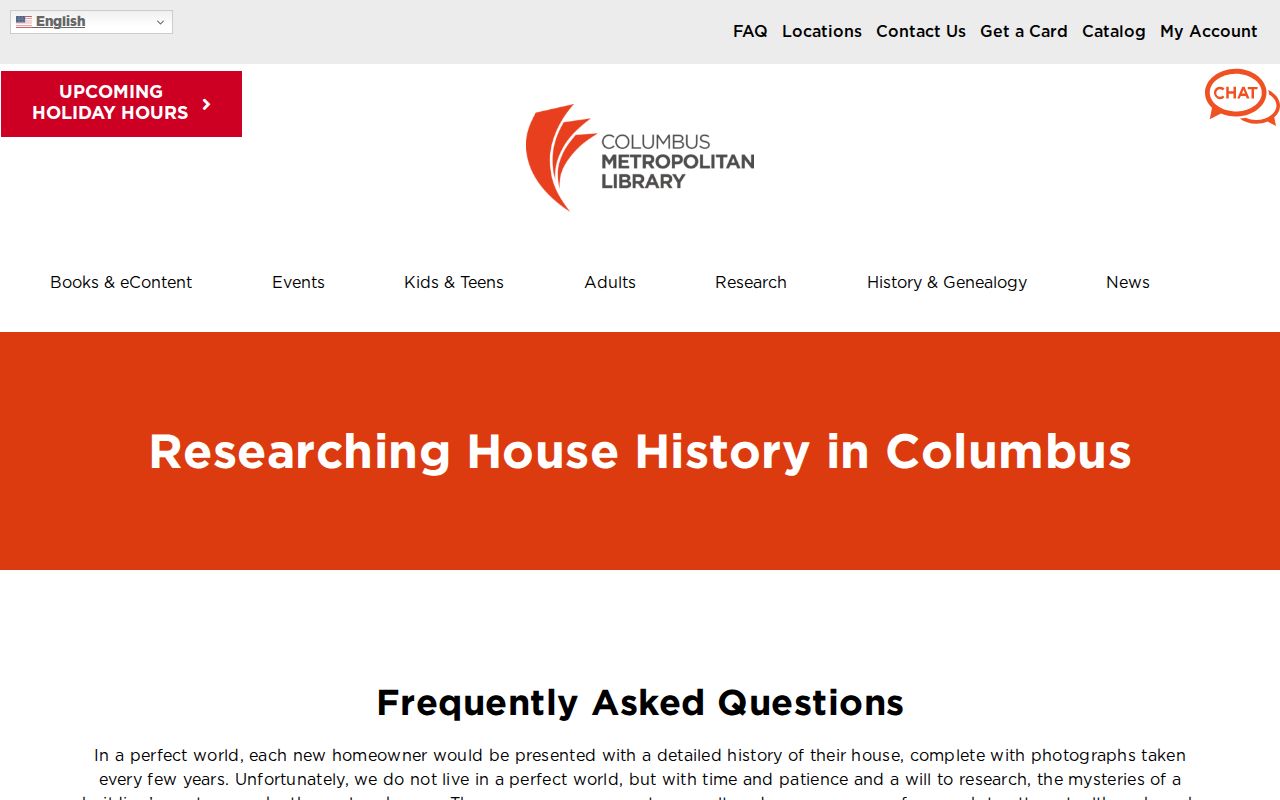
The library workflow image shows the useful bridge between address research and historical material. The correct county Recorder remains the next source when a parcel transfer must be verified.
For the current address chain or a whole named street, use the Reynoldsburg street directory lookup rather than stretching a historic household source into a current-neighbor list.
Reynoldsburg Previous Resident Trail Endpoints
Newspapers, cemetery material, death records, and Probate files can provide a trail endpoint when a person disappears from a directory or census. CML holds The News Gazette on microfilm from September 1910 through December 1940. Ohio History Connection’s death resources and the county Probate route must be used according to their own coverage and access rules. A death, estate, or obituary clue can locate a public historical record. It does not disclose private contact information for living people.
Lawful use. Reynoldsburg previous-resident research is suited to house history, family history, estate questions, and civic curiosity. Never use the resulting records to track, harass, threaten, or harm a living person.
Note: map evidence dates a building or land context, while a directory or census entry dates a listed household. Keep the two evidentiary roles separate.