
Reynoldsburg City Directory Collections
The 1939 booklet kept by the Reynoldsburg-Truro Historical Society, or RTHS, anchors everything. Columbus Metropolitan Library (CML) surrounds it with Franklin County phone books. CML also holds a broader digitized residents directory collection. The two resources do different jobs. The booklet covers the city and its rural routes directly. A Columbus-centered volume must be checked page by page. Only then does it count as Reynoldsburg coverage. Phone books list subscribers only, so not every household appears. That limit matters whenever a family or an older address is being traced.
| Collection | Years | Where Held | Access |
|---|---|---|---|
| Reynoldsburg Directory | 1939 | RTHS | Digitized and transcribed local source |
| Franklin County Ohio Bell books | 1928, 1932, 1936 | CML Digital Collections | Online subscriber directories that name Reynoldsburg |
| Columbus Telephone Directory | 1944 | CML Digital Collections | Online local-community and business listings |
| Columbus City Directory Collection | Selected 1843-44 through 1945 | CML Digital Collections and Main Library | Check each title and page for local coverage |
| CML street-address sections | From 1911 | CML Main Library | Street-order occupant reference, not ownership proof |
Armstrong, Riley, Nivens, Wiggins, Polk, and Dreher all appear among the CML publishers. A publisher's name alone promises nothing. The digitized collection is still growing, so confirm Reynoldsburg title by title.
The 1939 Reynoldsburg Directory
RTHS describes the booklet in its account of the 1939 Reynoldsburg Directory: nineteen pages printed by the Reynoldsburg Press for the city and its rural routes. That local scope gives it weight. A road, a route, or a household question fits it far better than a generic regional list. Still, it freezes one moment. People moved soon after publication. Others never earned an entry at all. Some appeared under a different spelling or a rural-route label instead of a street.
The directory page itself rewards careful copying. Save the initials, punctuation, and route wording exactly. Details carried over this way can bridge to a parcel, a phone-book entry, a newspaper item, or later family papers.
RTHS also preserves one street-name bridge: Broad Street in the 1939 Reynoldsburg directory is Broadwyn today. Treat that as a documented translation. It is not proof of a citywide address change. Old roads and cross streets deserve comparison with plats and legal descriptions, one address at a time.
Reynoldsburg City Directory Phone Books
CML's digitized Ohio Bell Franklin County books for 1928, 1932, and 1936 name Reynoldsburg outright. A 1944 Columbus directory does too. Between census releases these books earn their keep. They preserve a name, address, route, and exchange number. Still, they prove less than they first appear to, since an account holder may not have owned the property and others in the house may have had no phone. Run the same name in another year before concluding anything. The 1936 Franklin County phone book is one example.
Read the phone-book page as a guide, not gospel. Then compare another listed year. A shift from rural route to street, or a new exchange, can separate two similar people.
Reading Reynoldsburg Directory Entries
A 1939 entry can carry far more than a name. RTHS transcriptions show occupation or organization, a spouse in parentheses, children or other household names, a route, a street, a cross street, a town label, and a telephone exchange. Some entries even note a status like hired hand. Details cluster in tiny print. Copy the wording exactly as printed. A middle initial or a route abbreviation may be the only thing separating two similarly listed households.
| Indexed name | The person or household name as printed, including initials and spelling. |
|---|---|
| Role or work | An occupation, business, employer, or organizational clue where listed. |
| Household clues | A spouse in parentheses and sometimes children or other named household members. |
| Location | A street, route, cross street, town label, or numbered address. |
| Telephone clue | An exchange and number, such as the Reynoldsburg exchange abbreviation. |
- Criss-cross directory
- A directory arranged by street and house number rather than by name. CML’s street-address sections provide this kind of address-first aid.
- Householder index
- A name-oriented list that points to a household entry. It may omit other people who lived at the address.
- Abbreviation key
- The publisher’s list of shortened terms. Read it before assuming a mark proves a relationship or ownership.
A job title proves little by itself. Neither an occupation nor a phone listing establishes ownership, later addresses, or length of residence; the payoff is the dated connection and the next search terms it supplies.
Reynoldsburg Directory Addresses After 1911
CML's house-history guide traces Columbus directories back to 1841, with street-address sections beginning in 1911. They name occupants, not owners. An address entry is not a title claim. Ownership questions go to the county Auditor and Recorder. Reynoldsburg spans Franklin, Fairfield, and Licking Counties, so pick the right one.
The library's local-history shelf reaches well beyond directories. Maps, yearbooks, and house-history material sit nearby. Those companions test a directory clue. No single publication has to serve as a full population list.
For current address-keyed work, the Reynoldsburg street directory lookup takes the county route. It follows the parcel and recorder records. For a dated household listing, the old directories still win.
Tracing Reynoldsburg Directory Households
A household trail works best through dates, not gaps. Start from the strongest known listing and keep its exact form. Then check the years on either side. The latest open federal census is 1950, which adds dated snapshots rather than continuous proof between directory editions.
- Save the exact name, route or address, telephone clue, and household names from the first Reynoldsburg city directory entry.
- Check the 1928, 1932, 1936, or 1944 telephone-directory editions that fit the known period.
- Use a CML street-address section where available to test the address as an occupant location.
- Pair selected directory years with the released census and date each fact to its source.
- Use the correct county parcel and deed trail only when the question shifts from occupants to recorded ownership.
A vanished entry has several explanations. A move, a death, a new spelling, a dropped subscription, or a changed publication scope could all be the cause. Check newspapers, probate, cemeteries, and family papers separately.
Reynoldsburg Directory Research at RTHS
The RTHS historical database catalogs more than 3,500 local items. Tax maps sit alongside annexation ordinances, school records, newspapers, and periodicals. Its parcel sheets from 1920 through 1988 and its Franklin tax maps from 1895 to 1940 are especially useful for pinning a directory address to a street that has shifted over time. Treat them as supporting evidence. The Recorder's deed or plat still controls.
The RTHS collection earns its keep through sheer local depth. Its materials shine when a directory address lists a rural route, a cross street, or a neighborhood name. That name has often since faded from use. A modern map cannot decode those references. A Reynoldsburg-focused archive can.
Both RTHS and the Columbus library hold yearbook material. RTHS keeps Reynoldsburg High School composites plus a graduate-index reference. CML returns several Reynoldsburg yearbook years in search. Yearbooks serve family history or a former-classmate search, but they are not a current-resident list.
The Reynoldsburg-Truro research center and museum sits at 1485 Jackson Street. Its McNaghten Collection holds more than 300 binders of family-genealogy material. Maps, court records, letters, yearbooks, scrapbooks, photographs, and periodicals sit alongside them. RTHS also scans privately held material and returns it. A family photograph or clipping can supply a spelling, a road, a school, or a date. You can test each detail against a Reynoldsburg city directory. Attribute the item to its source either way.
CML's Main Library keeps local-history microfilm. That includes The News Gazette from September 1910 through December 1940. A dated newspaper notice can explain why a directory entry changed between editions. The directory remains the dated listing source. Neither record captures every Reynoldsburg household.
Reynoldsburg City Directory Context
CML's directory material runs from 1843-44 through 1945 and includes an 1889 Polk volume. Much of it is Columbus-centered. Early volumes still teach the publisher's layout and abbreviation style. But Reynoldsburg inclusion must be verified within the item. A Columbus city directory does not enumerate Reynoldsburg households. Its presence in a Franklin County collection does not change that. The 1889 CML directory entry shows the digitized collection and its searchable transcript format.
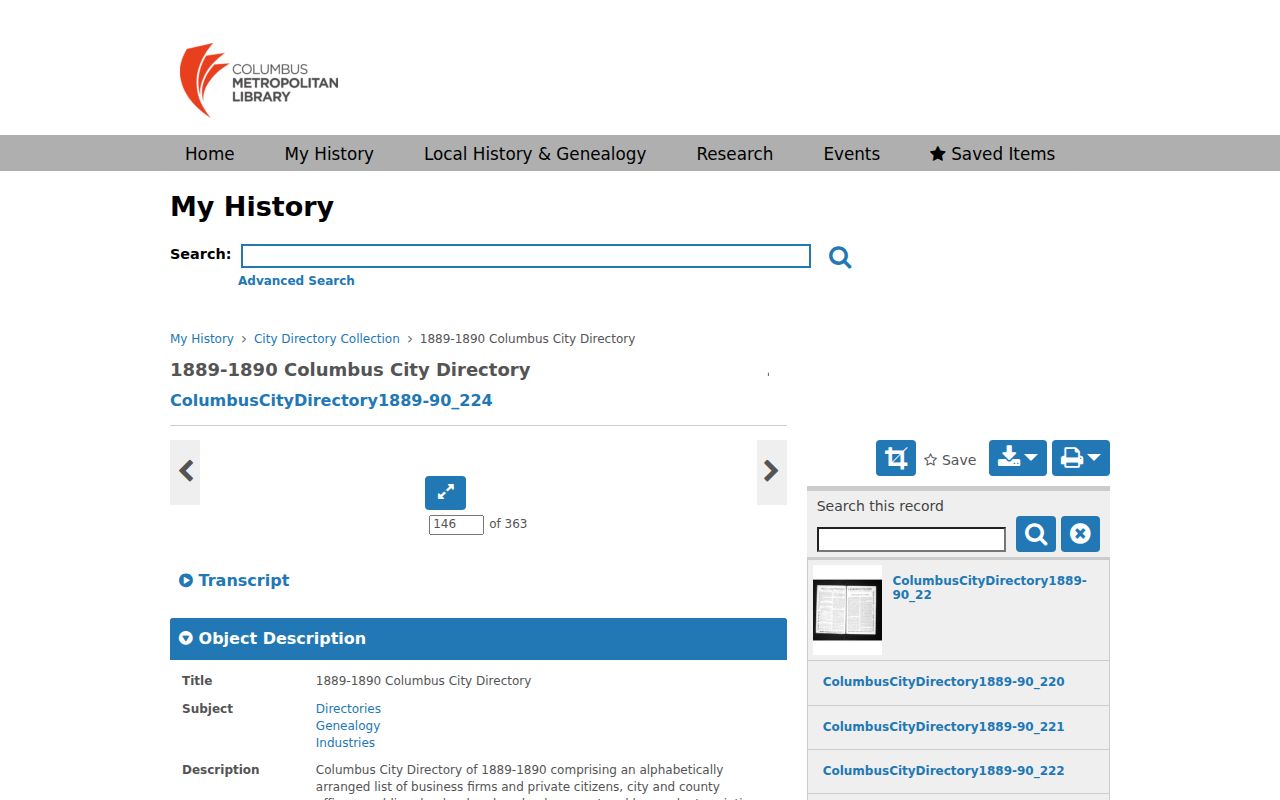
Use an older directory page to learn the collection and its coverage. Never assume a particular Reynoldsburg household appears in that edition.
Verify a Reynoldsburg Directory Find
Two independent records agreeing on a dated detail make a historical listing far more reliable. Compare spelling first. Then check the route or address. Add any spouse or household clue, plus the period. Only after that should a directory entry join a census record, a deed, an obituary, or a newspaper item. Use a county only after locating the parcel. Reynoldsburg spans three counties, so its postal name alone will not select the Recorder or the right court.
A historic listing sometimes needs a present-day check. A narrow Reynoldsburg resident lookup can compare official name-based records within the correct county. Never use a directory entry to infer a current address or expose private household details.
Note: RTHS identifies the local 1939 booklet, while broader CML coverage varies by item and should always be checked at the title and page level.
Reynoldsburg City Contact Directory
Two kinds of directories get confused for the Reynoldsburg residents directory. One records households. The other lists government staff. The Reynoldsburg staff directory belongs to the second group. It connects residents to current municipal offices and the services they run, not to a resident lookup of households and streets. A historical city directory, by contrast, preserves past residents of Reynoldsburg and the neighborhood listings of earlier decades. Keeping the two purposes apart prevents treating public employee contacts as a household-search tool.
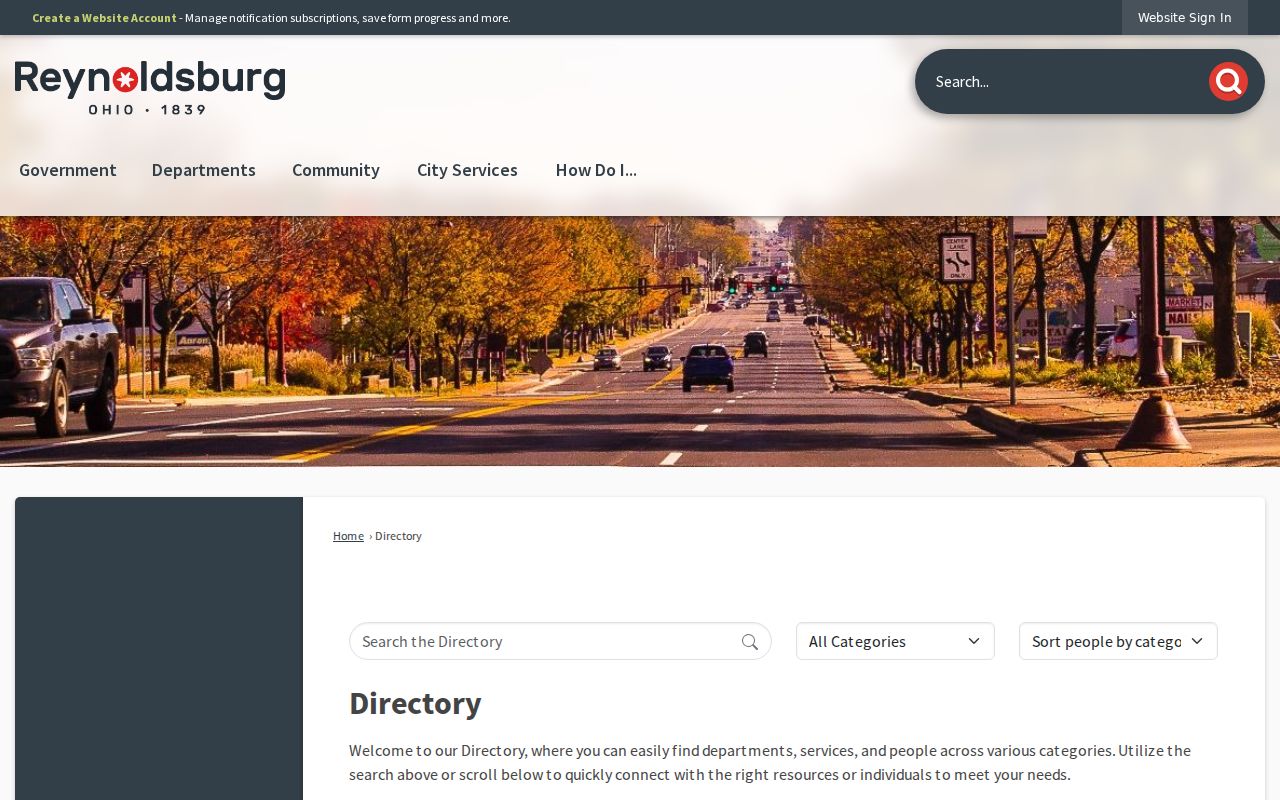
The staff-directory page shows the contrast plainly. It routes a records question to the right office, while the historical collections preserve the city directory listings of past residents and neighbors of Reynoldsburg.