
Finding Reynoldsburg Residents First
Begin with the fact that fits the record. A current street address is best for a county auditor search. A full name and approximate county can support an Ohio voter-registration check. A parcel, legal description, recorded date, or party name can move the search to a recorder index. For an older household, the Reynoldsburg-Truro Historical Society and Columbus Metropolitan Library collections can supply a directory or telephone-book entry. None of those sources is a universal list of people in town, and each records a different relationship to a place.
Use the physical address to choose the county before treating any result as a Reynoldsburg match. That first decision prevents a Franklin record from being mistaken for a Fairfield or Licking record. It also keeps an owner, a registration result, a court party, and a historic listed household in their proper lanes. Compare the indexed spelling, date, and location rather than relying on one name alone.
- Locate the address and its county with the City GIS or the appropriate county auditor route.
- Save the parcel or PIN, site address, legal description, and owner exactly as shown.
- Use the relevant recorder to connect the parcel clues to a recorded instrument and its parties.
- Use Ohio’s voter checker only to confirm a matching registration in the correct county.
- For older occupants or a missing city file, use the historical collections or make a focused public-records request.
Reynoldsburg Residents Across Counties
Reynoldsburg is one city spread across Franklin, Fairfield, and Licking Counties. Its postal name does not choose a deed custodian, court, election office, or tax record. The City’s three-county GIS locator brings city address points together with county parcel layers, making it a useful first pass. The county auditor and recorder then provide the authoritative property card and recorded-instrument route for that parcel.
County selection matters for events too. A Mayor’s Court matter, probate file, marriage license, or court case follows the county and jurisdiction involved, not merely the Reynoldsburg line in a mailing address. Historic work needs the same caution. The city expanded east and south over time, so an old parcel or event should be matched to its period and jurisdiction before a search moves into a county archive.
Note: A ZIP code and city name help identify a delivery address, but neither one reliably selects the office holding a Reynoldsburg record.
Reynoldsburg Residents Property Routes
Property records are the practical address-first route because they connect a physical site to a county parcel. Franklin’s Auditor GIS leads to Property Search and Parcel Viewer. Fairfield’s Auditor Real Estate Search separates deeded-owner and taxpayer-address fields. Licking’s Tax Parcel Viewer accepts an address, owner name, or Auditor PIN. Label the situs address, owner, and tax mailing address separately. A correspondence address does not establish that its recipient lives at the property, and a deeded owner is not every member of a household.
The Licking viewer has a particularly clear entry method. Start an address at its beginning and use abbreviated directional and road forms. Enter an owner as LastName, FirstName, including the space after the comma. A PIN may be entered without spaces or as 000-000000-00.000. Its map, layer, report, CSV, and buffer controls are useful for parcel research, but recorded deeds remain the source for title questions.
- Parcel or PIN
- A county’s identifying number for one property record.
- Situs address
- The physical location of the property.
- Tax mailing address
- The correspondence destination shown for tax purposes, which can differ from the situs address.
- Legal description
- The lot, subdivision, plat, or other land description used to identify property in a recorded instrument.
| Licking viewer field | How it works | Useful result |
|---|---|---|
| Search | Beginning of abbreviated address, owner as last name then first name, or Auditor PIN | Selected parcel and map context |
| Buffer distance | Enter a distance in feet around a selected map feature | Nearby parcel set for later verification |
| Layers | Turn live map layers on or off | Spatial context, not a legal survey |
| Report or CSV | Use the viewer’s download controls | Parcel research output when available |
The Licking County Tax Parcel Viewer shows the address, owner, PIN, and mapping controls used for a Reynoldsburg parcel search.
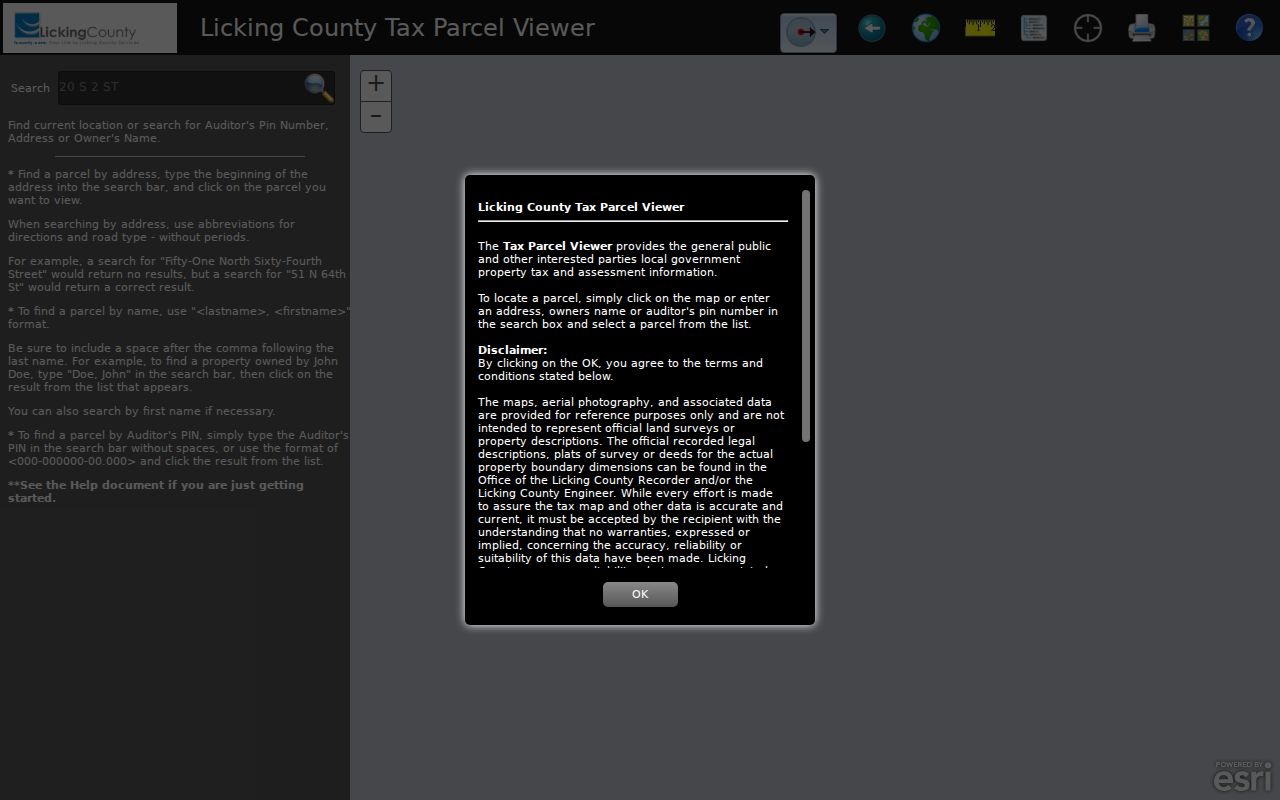
Once the viewer identifies a parcel, retain the PIN and site details before checking the county recorder. That handoff keeps the address trail tied to the correct county record.
Note: Licking mapping data is a reference tool and not an official land survey or a substitute for a recorded plat or deed.
Reynoldsburg Residents Recorder Bridge
Recorder indexes turn a parcel clue into a document trail. Franklin County Recorder Public Records Search allows a general text search for a party name, address, or parcel identification number, with a recorded-date limiter. Advanced Search supports book, volume, and page retrieval. The useful details to preserve are the indexed party name and role, instrument or document number, recording date, document type, book or page reference where shown, and image or redaction status.
Franklin’s recorder does not index property addresses as a universal field. An address search therefore needs an auditor-to-parcel handoff, followed by a party, legal-description, instrument, or book-page search. In Licking, Recorder DTS Public Access is the online gateway; a free account can save searches and a document cart. Neither the Licking gateway nor the Franklin landing page states one universal online start date, so an older no-result should lead to the recorder counter or historic deed-book channel rather than a conclusion that no instrument exists.
Reynoldsburg Resident Records Offices
County offices keep the central parcel and instrument records, while the City holds only particular municipal records. The City of Reynoldsburg does not maintain a citywide household roll. Its staff directory, Mayor’s Court gateway, police records channel, and address-specific building or code files document defined city relationships. For an address-led question, begin with the correct county property route; use the City when the question is a defined city record, such as a report, permit, inspection, or Mayor’s Court matter.
Reynoldsburg Police Records
7240 E. Main St.
Reynoldsburg, OH 43068
614-866-6622, option 2
Franklin County Recorder
373 S. High St., 18th Floor
Columbus, OH 43215
614-525-3930
Fairfield’s County Records Search hub keeps real-estate, Common Pleas, Municipal Court, Probate, public-records, and Ohio Land Records paths separate. That separation is helpful in the Fairfield part of Reynoldsburg because a property result, a court result, and a recorded document answer different questions.
Reynoldsburg Resident Voter Check
Ohio’s My Voter Information requires a first name, last name, and county. Select Franklin, Fairfield, or Licking only after the address county is known. A street-name choice can appear when the name produces more than one possible registration. Search tips include trying a familiar name variation, a former last name, or a former Ohio address. The result is a registration, precinct, and polling-location confirmation route, not an address roster.
Ohio law makes voter records public with important exceptions. Protected fields include identifiers and contact details, Safe at Home records, and qualifying redactions. County boards also have distinct public-file and report routes. The Franklin Board of Elections publishes a Reynoldsburg city-or-village file for its county portion, while Fairfield and Licking provide report interfaces with live options. A precise request to the correct county board is the fallback for a lawful civic record that is not available in the visible interface.
Reynoldsburg Residents Court Checks
The Reynoldsburg Clerk of Courts provides a CourtView gateway for Mayor’s Court case information and eligible ticket payment. Mayor’s Court handles most city traffic and criminal misdemeanor matters within the Police Division and building-code jurisdictions, but its jurisdiction is limited. Juvenile cases, civil claims, domestic-violence charges, protection-order violations, and other defined matters are not simply missing results. They may belong in the appropriate county system or be protected.
Use a case or ticket number when available. If there is no online result, the clerk counter and phone are the documented fallback. County court and probate routes still depend on the physical address or case jurisdiction. An online docket is an index, not a complete file, and sealed, juvenile, adoption, and protected personal information may not be available.
The Mayor’s Court gateway is the starting point for the defined city-court route.
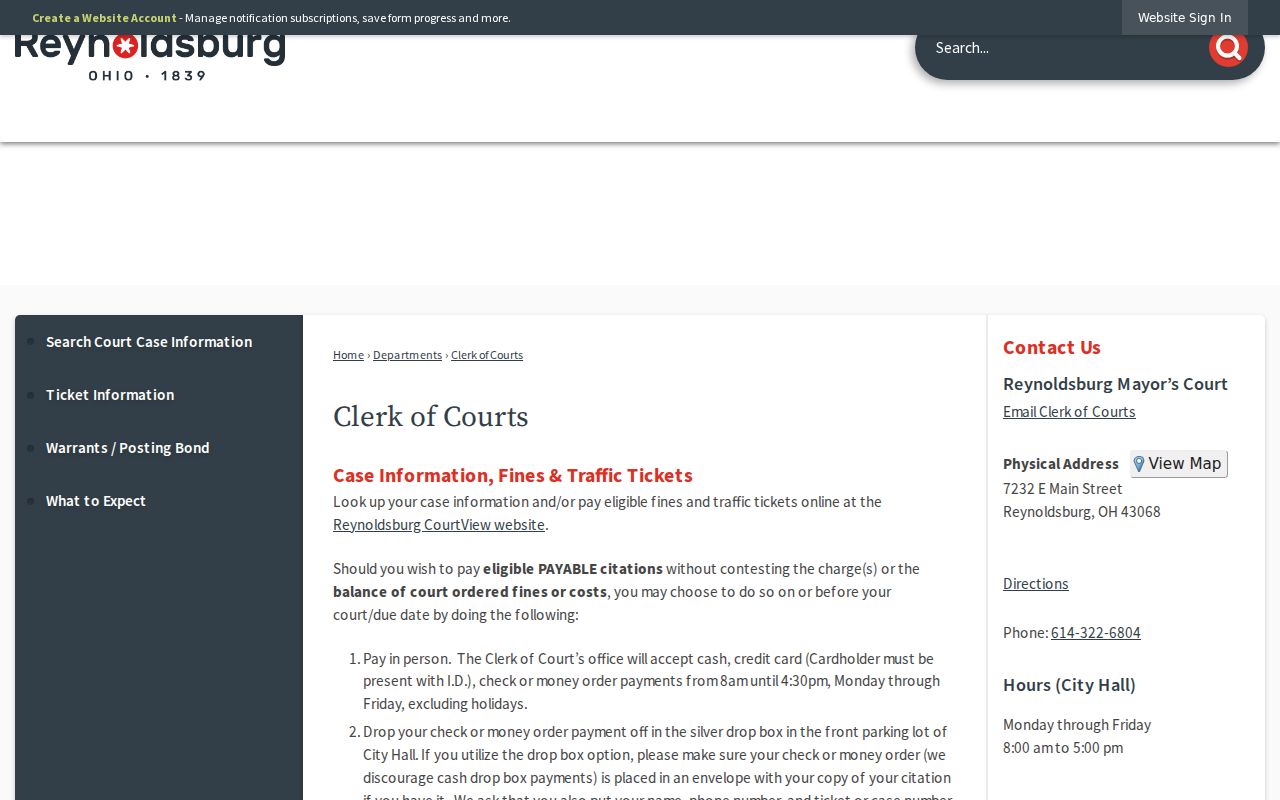
The CourtView link can help locate an eligible city-court matter, while a county clerk route is needed whenever the matter falls outside Mayor’s Court jurisdiction.
Current Reynoldsburg Resident Directories
Current resident research works best when the source is chosen for the fact it can actually show. The county property card can identify a parcel and recorded owner. A recorder index can identify parties to a document. Ohio’s voter tool can confirm registration for a matching name and county. The City staff directory identifies public office contacts, not households. Each result should retain its original labels, especially site address versus tax mailing address and party role versus a claim of present residence.
| Current source | What it can show | Keeper | Access route |
|---|---|---|---|
| County property card | Parcel, site, owner, mailing field, value and transfer context | Correct county Auditor | Address, owner, parcel, or PIN search |
| Recorded instrument index | Party, document event, date, and legal or parcel clues | Correct county Recorder | Online index plus counter or historic books |
| Voter registration check | Matching registration, precinct, and polling details | Ohio Secretary of State and county BOE | First name, last name, county |
| City staff directory | Named public office contacts and department channels | City of Reynoldsburg | Online directory |
| City request channel | Specified releasable city reports or address files | Reynoldsburg Police Records | Email, phone, form, mail, or counter |
The Ohio DRC Offender Search is another official system with a much narrower purpose: it covers state correctional custody or supervision data, not a local-jail roster or complete court history.
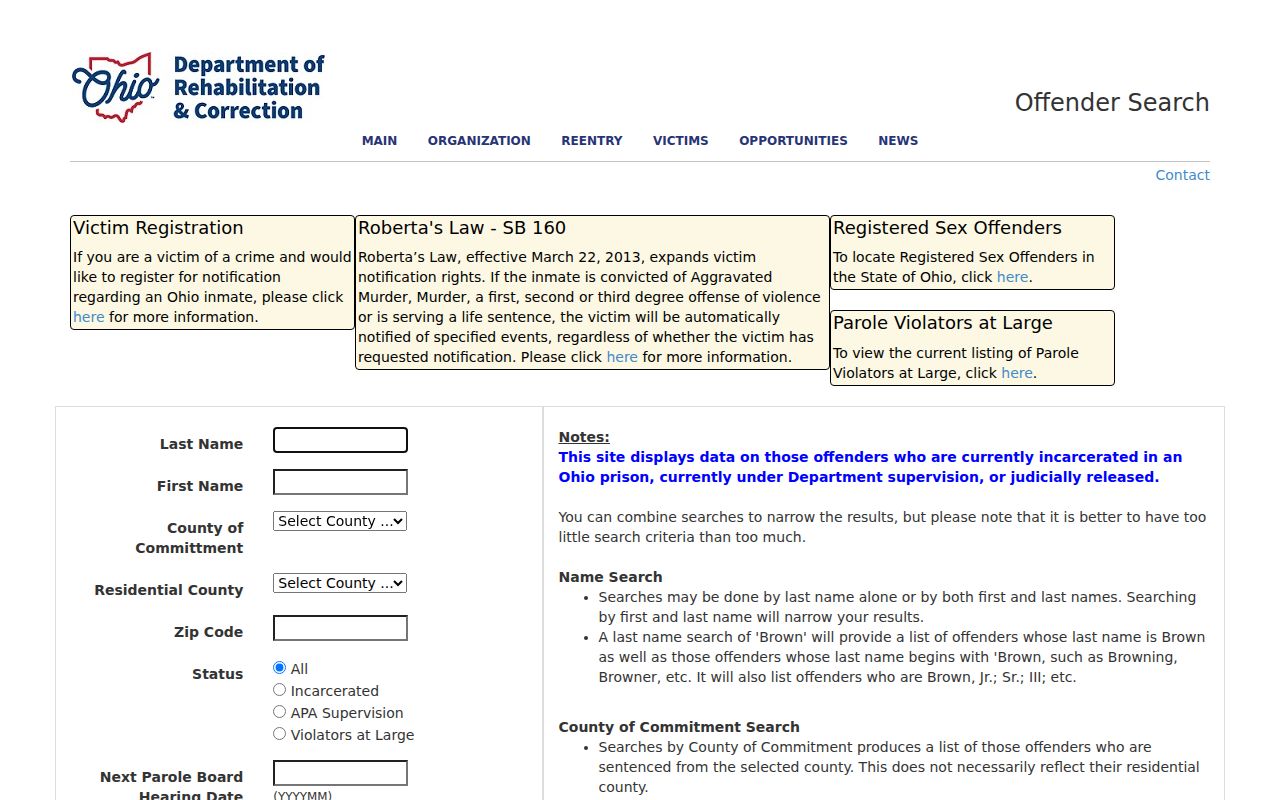
A result from that state system should be read with its own status and date limits, then checked against the proper court record when a lawful record question remains.
Reynoldsburg Resident Source Comparison
Official indexes have a traceable custodian, field labels, and a counter or request fallback. Commercial people-finder products compile mixed public, online, and commercial inputs, can merge people with similar names, and use their own opt-out paths. An opt-out from a commercial product does not change a county Recorder, Auditor, Board of Elections, or court record. Ask the office holding the original record to correct a documented error.
| Route | Best use | Key boundary |
|---|---|---|
| Official county or city record | Verify a defined parcel, document, case, or city file | It answers only the record question in its custody |
| Historical library or society collection | Place a household in a past directory year or local source | Listing coverage is incomplete and point-in-time |
| Commercial listing category | Check whether its data needs independent verification | May be stale, conflated, or removable only at that provider |
Reynoldsburg Historical Resident Directories
Historical resident rolls are strongest when the source is specific to Reynoldsburg. The 1939 Reynoldsburg Directory, published by The Reynoldsburg Press, covers the city and its rural routes in 19 pages. Its entries can include a listed name, role, spouse or other household names, street or route, and telephone exchange. That makes it useful evidence of a listed household at one point in time, not proof of ownership, a precise move date, or continuous residence.
Columbus Metropolitan Library has digitized Ohio Bell Franklin County telephone books that explicitly include Reynoldsburg for 1928, 1932, and 1936, plus a 1944 Columbus telephone directory with local communities. The Reynoldsburg directory book gives the fuller collection-by-collection route. A no-result in a telephone book can reflect an unlisted number, spelling change, rural route, or absence from that edition rather than an absence from town.
For a past address, match the entry’s spelling, route, or cross-street wording to a parcel, historic plat, or deed description before forcing it into a modern street address. RTHS notes that Broad Street in the 1939 directory is now Broadwyn, a useful local translation rather than a citywide renaming rule.
Reynoldsburg Residents Family Trails
Family-history and reconnection work has local shelves as well as county portals. RTHS maintains a research center and museum at 1485 Jackson Street, a database describing more than 3,500 items, and the McNaghten Collection of more than 300 binders. Its material includes maps, court material, letters, yearbooks, scrapbooks, photos, newspapers, and local periodicals. Reynoldsburg High School composites and a graduate-index reference add a route for a former classmate or family question that does not depend on a modern property result.
Columbus Metropolitan Library Local History & Genealogy adds central-Ohio directories, maps, government records, yearbooks, microfilm, and organizational papers. Pair one dated directory entry with the released federal census, a county parcel or deed, a newspaper, or a probate trail. That pairing is more reliable than treating any one historical listing as a complete household history.
Reynoldsburg’s growth from a road-centered settlement to a three-county city is visible in those materials. The 1872 Franklin County atlas labels Main Street or National Road, Broad, South, Ash, Jackson, and Lancaster Streets, along with local landholders and institutions. It can help decode an older place description when used beside a legal description or parcel record.
Reynoldsburg Residents Public Requests
When a needed city record has no public search screen, make a narrow request. Reynoldsburg Police directs requesters to publicrecords@reynoldsburg.gov or 614-866-6622, option 2. Include the specific names, date range, location, and report, permit, or case detail that can help staff find the record. The City provides a request form and accepts email, phone, mail, and in-person channels. Electronic copies are listed without charge on the current police request page, while its separate published copy schedule applies to other formats.
Ohio Revised Code 149.43, the Ohio Public Records Act or Ohio Sunshine Law, requires prompt inspection and copies within a reasonable period, subject to redactions and other statutory limits. A form can improve specificity, but Ohio law does not make a written request, identity, or purpose mandatory merely to ask for a record. The strongest request names the custodian, record type, address or parcel, date span, and any known report, instrument, or case number.
The Ohio Public Records Act source sets the statewide inspection, copying, and redaction framework for a focused Reynoldsburg request.
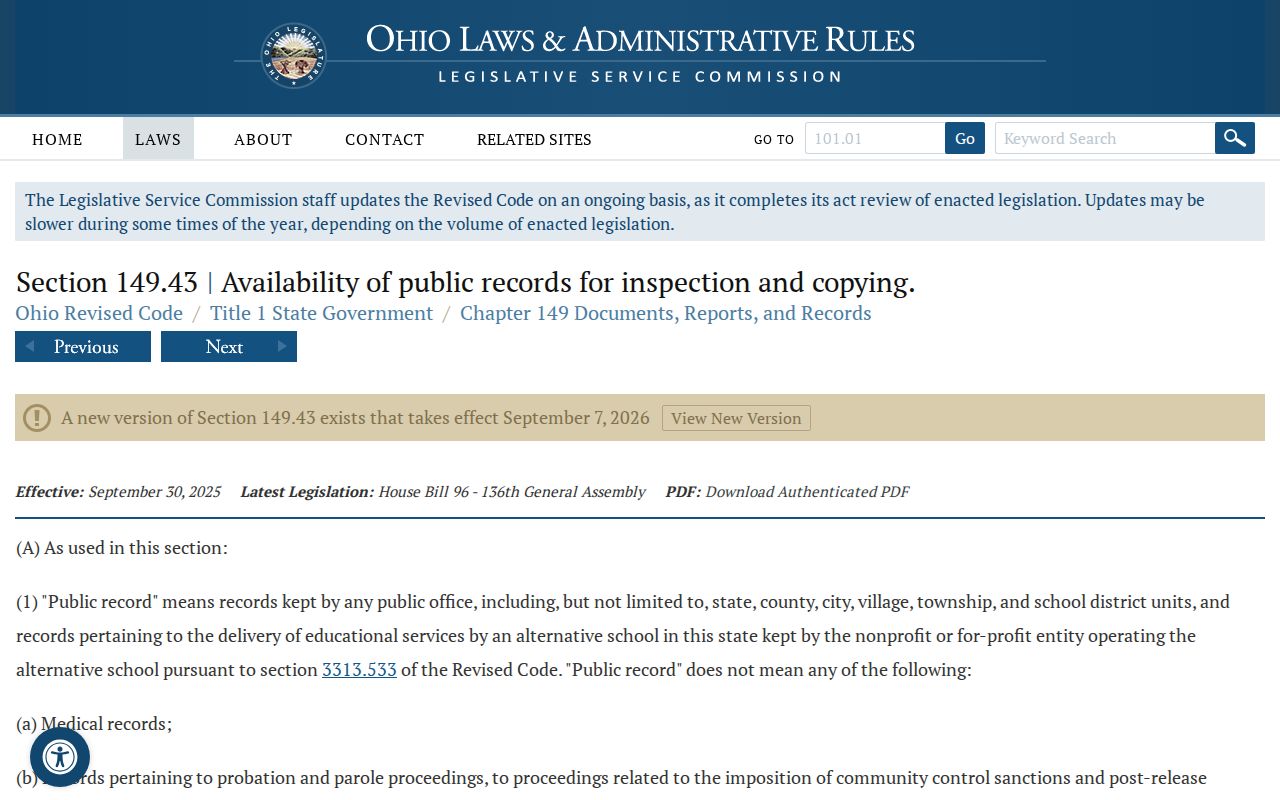
A targeted request can obtain or clarify a nonexempt city record, but it does not turn protected information or an untargeted search into an available record.
Reynoldsburg Residents Privacy Limits
A missing address or redacted field can reflect a legal protection rather than a bad search. Ohio Safe at Home lets eligible participants use a substitute address in public records. Request forms and confirmation letters under R.C. 149.45 are excluded from the ordinary public-record definition. That protection, along with protected voter fields, sealed court records, and restricted motor-vehicle information, means a public property or court trail cannot be expanded into a complete household file.
R.C. 149.45 also provides defined current or former public-service workers a written route to seek qualifying personal-information redaction from online public records. It is not a universal removal right and has exceptions, including county Auditor records. The statute’s redaction rules and the actual custodian are the right places to check when information is protected or a correction is needed.
Note: Voter, property, court, and recorder records each have their own access limits, so a no-result should be confirmed with the correct office.
Reynoldsburg Residents Record History
Older Reynoldsburg research needs a record-history check. Franklin’s archive deed index reaches 1804 through 1913, while the modern deed index begins January 2, 1914. The Franklin courthouse fire of 1879 caused losses, although the Recorder reports that most records were reconstructed. Licking has a separate caution: its 1875 courthouse fire affected early material, and its Records & Archives channel is important when the online trail ends.
RTHS holds Franklin Auditor parcel sheets for 1920 through 1988 and tax maps for 1895 through 1940, which can bridge periods of city growth and annexation. For a Licking, Fairfield, or Franklin address, keep the historic jurisdiction in the research notes. A present-day city label should not be projected backward onto an older parcel, court, or recorder system without checking the address history.